سلة الشراء
لا توجد أية عناصر أخرى في عربة التسوق



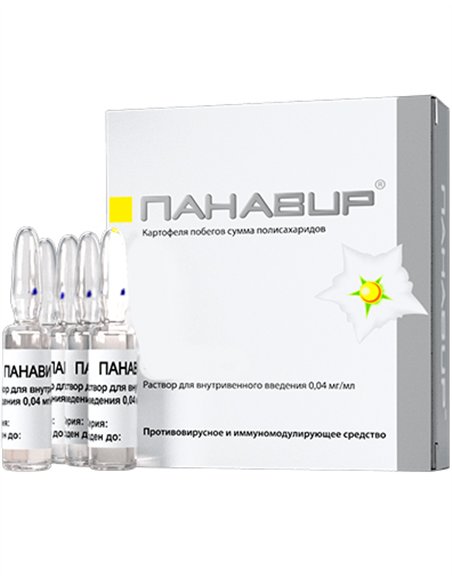
Panavir® is a purified extract of the shoots of the Solanum tuberosum plant; its main active ingredient is a hexose glycoside consisting of glucose, rhamnose, arabinose, mannose, xylose, galactose, and uronic acids.
Panavir® is an antiviral and immunomodulatory agent. It increases the body's nonspecific resistance to various infections and promotes the induction of alpha and gamma interferons by blood leukocytes.
Indications for use
Herpesvirus infections of various localizations (including recurrent genital herpes, herpes zoster, and ophthalmic herpes).
Secondary immunodeficiency states due to infectious diseases.
Cytomegalovirus infection, including in patients with recurrent miscarriage.
Used in women with chronic viral infections and interferon deficiency during pregnancy preparation.
Chronic cytomegalovirus infection in the acute stage in pregnant women in the second and third trimesters as part of combination therapy.
Human papillomavirus infection (anogenital warts) as part of combination therapy.
Gastric and duodenal ulcers in patients with long-term scarring and symptomatic gastroduodenal ulcers as part of combination therapy.
Tick-borne encephalitis to reduce viral load and relieve neurological symptoms (anisoreflexia, decreased reflexes, tenderness at cranial nerve exit points, nystagmus) as part of combination therapy.
Rheumatoid arthritis combined with herpesvirus infection in immunocompromised patients (to enhance the analgesic and anti-inflammatory effect of the primary therapy), as part of combination therapy. Acute respiratory viral infections and influenza as part of combination therapy.
Panavir® is used in the combination therapy of chronic bacterial prostatitis.
The drug is well tolerated at therapeutic doses.
Trials have shown no mutagenic, teratogenic, carcinogenic, allergenic, or embryotoxic effects. Preclinical studies in laboratory animals have not revealed any negative effects on reproductive function or fetal development.
It exhibits anti-inflammatory properties in experimental models of exudative edema, chronic proliferative inflammation, and a pseudoallergic inflammatory response test to concanavalin A.
Analgesic activity has been demonstrated in models of neurogenic pain and pain caused by inflammation and thermal irritation.
It has antipyretic properties.
Neuroprotective properties have been demonstrated in a model of Parkinson's syndrome caused by systemic administration of the neurotoxin 1-methyl-4-phenyl-1,2,3,6-tetrahydropyridine. It has the ability to improve retinal and optic nerve function.
It has wound-healing properties in a gastric ulcer model.
Panavir® should be administered intravenously by slow intravenous stream.
The therapeutic dose is 200 mcg of the active ingredient (the contents of one ampoule or vial).
For the treatment of herpesvirus infections and tick-borne encephalitis, it is administered twice, 48 or 24 hours apart. If necessary, the course of treatment can be repeated after 1 month. For the treatment of cytomegalovirus and human papillomavirus infections, the drug is administered three times during the first week at 48-hour intervals and twice during the second week at 72-hour intervals.
For the treatment of acute chronic cytomegalovirus infection in pregnant women during the second and third trimesters, the drug is administered three times during the first week at 48-hour intervals and twice during the second week at 72-hour intervals.
For the treatment of acute gastric and duodenal ulcers and symptomatic gastroduodenal ulcers, 5 intravenous injections are administered every other day for 10 days.
For the treatment of rheumatoid arthritis associated with herpesvirus infection in immunocompromised patients, 5 intravenous injections are administered at 24-48-hour intervals. If necessary, the course is repeated after 2 months.
For the treatment of acute respiratory viral infections and influenza, two intravenous injections are administered at intervals of 18-24 hours.
For the treatment of patients with chronic bacterial prostatitis, five intravenous injections are administered at intervals of 48 hours.
PEDIATRIC USE: Panavir® is prescribed to children 12 years and older at a dose of 100 mcg intravenously once daily.
For the treatment of herpesvirus infections and tick-borne encephalitis, the drug is administered twice at intervals of 48 or 24 hours. If necessary, the course of treatment can be repeated after one month.
For the treatment of cytomegalovirus and human papillomavirus infections, the drug is administered three times during the first week at intervals of 48 hours and twice during the second week at intervals of 72 hours.
4670008161926
4670008161926
670008161926
Tap to zoom