Shopping Cart
There are no more items in your cart



Important (for sprays)! Before screwing on the dispenser, remove the protective ring from the bottle cap.
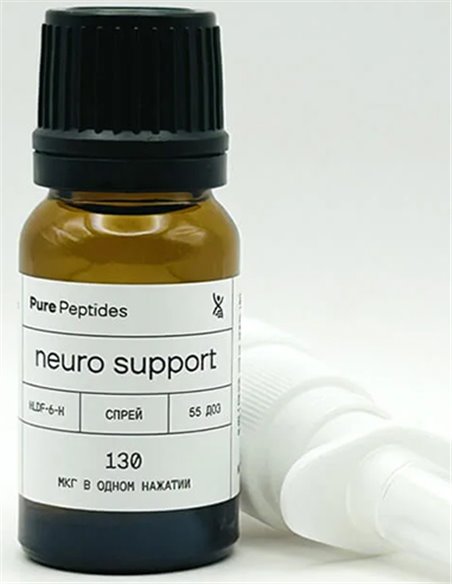
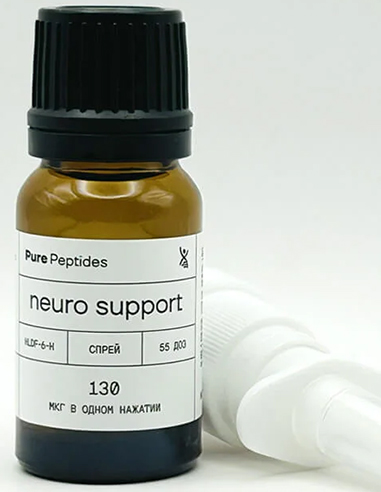
Neuro Support spray
130 mcg per press · 55 doses
Description:
Neuro Support is a hexapeptide whose amino acid sequence (Thr-Gly-Glu-Asn-His-Arg, TGENHR) is fragment 41–46 of the human leukemia differentiation factor (HLDF)
In nature, this region acts as a molecular “key” for activating protective and restorative programs in neurons.
Mechanism of action (experimentally confirmed)
Neuroprotection — protection of neurons from apoptosis, stabilization of mitochondria.
Neuroplasticity — increase in BDNF, restoration of synaptic contacts.
Normalization of mediator metabolism — balancing of dopamine and glutamate.
Anti-inflammatory effect — reduction of IL-1β, TGF-β1, IFN-γ.
Androgenic effect — in animal studies, it increased testosterone levels by 1.5–2 times in males with its initial deficiency, restored sexual behavior and sensitivity to pain stimuli; in animals with normal hormone levels, a moderate decrease in aggression and motor activity was observed.
1. Neuroprotection in the Parkinson's disease model
In an experimental model of Parkinson's disease (MPTP, C57Bl/6 mice), TGENHR administered intranasally (300 µg/kg for 3 weeks) restored normal dopamine levels and its turnover in the striatum, improved motor function — according to the horizontal grid test of average results — and increased the BDNF level. The expression of proinflammatory mediators (TGFβ1, IL‑1β, IFNγ) was also normalized.
2. Anti-inflammatory and antidepressant action of HLDF-6-H
In a similar model at the pressymptomatic stages of Parkinson's disease, TGENHR reduced the activity of inflammatory markers (leukocyte elastase and α1-protein inhibitor) and reduced the manifestations of depressive behavior (Forsalt test), probably through the regulation of corticosteroids and sex hormones.
Other studies on TGENHR
Neuroprotection and nootropics
Studies of TGENHR in models of stroke and Alzheimer's disease have shown that the amide has significantly greater activity than the carboxyl form - it is effective at low doses (e.g. 250 µg/kg), exceeding the results of such drugs as mexidol at a much lower dose, and is not toxic.
Pharmacokinetics and metabolism
Studies on animals (rats, mice, rabbits) with labeled isotopes (tritium, deuterium) of TGENHR have shown high bioavailability when administered intranasally (~34%), as well as rapid disappearance from the blood due to active proteolysis. Most metabolites were identified and the main pharmacokinetic parameters were calculated.
Other pharmacological effects
TGENHR stimulates testosterone biosynthesis in males (in the testicles and adrenal glands).
In experiments with withdrawal syndrome (opiates), TGENHR reduced withdrawal symptoms - it is proposed that the mechanism is associated with the inhibition of enkephalinase A.
TGENHR exhibits neuroprotective effects in Alzheimer's disease models (in vitro and in vivo), preventing memory loss and reducing neuronal death in the hippocampus.
TGENHR has been shown to have an anxiolytic effect - comparable to diazepam - in stress-sensitive mice; the mechanism may involve actions on the NMDA-glutamatergic system and a decrease in the density of 5-HT₂A receptors in the prefrontal cortex.
Conclusion
The TGENHR peptide shows promising therapeutic potential, especially in models of neurodegenerative diseases and conditions associated with inflammation and depression:
Neuroprotection: improved motor skills, restoration of dopaminergic functions, normalization of neurotrophic and inflammatory markers - especially in Parkinson's models.
Anti-inflammatory/antidepressant action: reduction of inflammation markers, reduction of depression, correlation with hormonal changes.
High efficiency at low doses, together with good bioavailability with intranasal administration.
Additional effects: improvement of cognitive functions, anxiolytic activity, influence on hormonal status and stress reactions.
Potential application:
Neurodegenerative diseases
Parkinson's disease (in the early and prodromal stages - to protect dopaminergic neurons).
Alzheimer's disease (slowing down cognitive decline, protecting the hippocampus).
Other dementias with pronounced neuroinflammation and oxidative stress.
Vascular and ischemic brain damage
Consequences of ischemic stroke (to restore cognitive and motor functions).
Chronic cerebral ischemia (dyscirculatory encephalopathy).
Traumatic brain injury
Mild and moderate traumatic brain injury (including post-concussion syndrome).
Sports and professional injuries with the risk of cognitive impairment.
Cognitive impairment of various genesis
Mild cognitive impairment (MCI).
Memory, attention, and thinking speed impairments in metabolic and endocrine disorders.
Professional cognitive fatigue in people with

Tap to zoom